Coin Highlights
- Contains 1 oz of .9999 fine gold;
- Bullion coin;
- Produced by the US Mint;
- Face value of USD 50, guaranteed by the US Government;
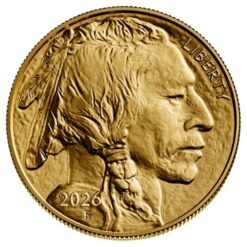
- The obverse depicts a Native American Chief;
- The reverse features the American Bison
The Design
A refined version of the 1913 Indian Head Nickel, designed by James Earle Fraser, is depicted on the obverse. It showcases a right-facing portrait of a Native American, created by combining features from notable tribal figures, including Big Tree, Iron Tail, and Two Moons.
The design also contains the inscriptions “LIBERTY” near the forehead, the mintage year, and an “F” at the lower left, signifying Fraser’s initials.
The reverse portrays an American Bison, the inspiration for the coin’s name.
The depiction is accompanied by the engravings “UNITED STATES OF AMERICA” and “E PLURIBUS UNUM” arched around the outer rim, while “IN GOD WE TRUST” appears near its muzzle. Beneath the bison are details indicating the coin’s denomination, weight, metal content, and purity, reading “$50,” “1 OZ .9999 FINE GOLD.”
The gold Buffalo is America’s first pure gold bullion coin. Its weight and purity are guaranteed by the U.S. government.
The Presidential $1 Coin Act authorized the production of these 24-karat coins on December 22, 2005. The design for these coins resurrected the work of American sculptor James Earle Fraser for America’s five-cent coin, which popularly came to be known as the “Indian Head,” or “Buffalo Nickel.” It was introduced in 1913 and celebrates the American West with the noble Indian profile on the obverse and the buffalo on the reverse.
According to the U.S. Mint, the Native American depiction is a composite of three different individuals, with two of them identified by the artist before his death as Chief Iron Tail of the Lakota Sioux and Chief Two Moons of the Cheyenne. While there have been many who have said that they sat for Fraser, the artist could not recall the third person. It’s widely believed that Fraser used “Black Diamond,” a buffalo who lived in New York’s Zoological Gardens, as the model for the bison on the coin’s reverse.
Notably, James Earle Fraser created one of the best-known American sculptures in America. Entitled “End of the Trail,” it was completed before Fraser was 17 years old in 1894 and won the $1,000 award of the American Art Association in Paris. This award brought Fraser to the attention of Augustus Saint-Gaudens, the designer of the $10 and $20 eagle and double eagle coins. Saint-Gaudens, a member of the association’s jury that selected Fraser for the award, later asked Fraser to become his assistant.